
Indian oil marketing companies are incurring significant losses, selling petrol at a Rs 14 per litre loss and diesel at Rs 18 per litre, as elevated global crude oil prices, exacerbated by the West Asia crisis, outpace capped retail fuel rates, according to rating agency Icra.

'In all these years of rupee depreciation, of rising oil prices, of inflation caused by import dependence, not one leader had the courage to look the people in the eye and say: Please do this for your country.'

'Decisions on talent and rewards have shifted as employees and companies are operating in a buyer's market across most skill categories.'

Companies in the fast-moving consumer goods (FMCG) sector are losing favour with equity investors, with their price-to-earnings (P/E) ratio declining to its lowest level in six years, now trading at 38.8 times trailing earnings.

According to the minister, India needs to expand its manufacturing sector to boost exports and ensure sustainability.

The IHS Markit India Manufacturing PMI rose from 51.2 in November to 52.7 in December. Factories benefited from a rebound in demand, and responded by scaling up production to the greatest extent since May. As per the survey, new work orders witnessed marked improvement, with the pace of expansion picking up to the fastest since July.

The main factor boosting production was a sustained rise in new work inflows.

India's leading passenger vehicle manufacturers are significantly increasing investments and factory capacities, alongside planning major product launches for FY27, driven by strong confidence in sustained domestic demand growth despite global geopolitical tensions and supply chain risks.

Factory output as measured in terms of IIP had grown by 7.3 per cent in December 2017.

Foreign secretary Vikram Misri on Friday shared key details on agreements between India and the UAE, stating that the UAE will store up to 30 million barrels of crude oil in India's strategic petroleum reserve following Prime Minister Narendra Modi's visit.

Amid the arithmetic of subsidies, consumption and capacity, whichever government assumes office in Tamil Nadu after May 4 is likely to inherit a growing debate over how far the state can continue to expand welfare promises without placing additional strain on public finances and the power sector.
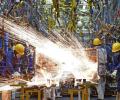
This is the ninth consecutive month that the manufacturing PMI remained above the 50-point-mark.

A gangster was arrested in Chandigarh after a brief exchange of fire with police. The accused, Mukesh alias Golu Gohana, sustained a bullet injury during the encounter and is currently hospitalised. Police recovered a pistol and cartridges from his possession.

Employees with artificial intelligence skills are likely to see better salary increments in the coming years, especially in technology, GCCs, and BFSI sectors, according to TeamLease Edtech.
Employees with artificial intelligence skills are likely to see better salary increments in the coming years, especially in technology, GCCs, and BFSI sectors, according to TeamLease Edtech.

The Indian banking sector is projected to experience a steady 9-13 per cent industrial credit growth in the first half of 2026, driven by capital expenditure, infrastructure development, and sectoral demand recovery, according to a Ficci-IBA survey.

India's home-grown EV startups say the government's auto PLI scheme is helping big players while shutting out innovators building electric two- and three-wheelers from scratch.

The Nikkei India Manufacturing Purchasing Managers' Index (PMI) stood at 47.9 in July, down from 50.9 in June, its lowest mark since February 2009, and highlighted the first deterioration in business conditions in 2017 so far.

The CJP's rapid rise on social media reflects growing digital dissent and youth frustration with issues like unemployment and exam-paper leaks.

The United States has announced a preliminary countervailing duty of 125.87 per cent on imports of certain Indian solar goods, alleging unfair subsidisation. This move could impact India's renewable energy sector and its efforts to boost domestic solar manufacturing.
The country's manufacturing sector activity grew at the slowest rate in four months during March, hampered by softer rises in new business as international demand faltered owing to the coronavirus pandemic, a monthly survey said on Thursday. The headline seasonally adjusted IHS Markit India Manufacturing PMI fell to 51.8 in March, from 54.5 in February, signalling the slowest improvement in business conditions since November 2019. This is the 32nd consecutive month that the manufacturing PMI has remained above the 50-point mark.

The recovery in manufacturing is still likely to prove "protracted" given the lingering structural constraints.

Exporters of gems and jewellery have said the free-trade agreement (FTA) has brought relief to their sector because this opens up the world's second-largest market and brings them on a par with China and Thailand, which face zero tariffs on shipments to Europe.

India's manufacturing sector activity eased to a nine-month low in November, mainly owing to softer rise in sales and production amid reports of challenging market conditions, a monthly report said on Monday. The seasonally adjusted HSBC India Manufacturing Purchasing Managers' Index (PMI) falling to 56.6 in November from 59.2 in October, highlighted the slowest improvement in operating conditions since February.

Mahindra & Mahindra Ltd reported a significant 48.5 per cent jump in consolidated profit after tax to Rs 5,259.91 crore in the March quarter, primarily attributed to strong performance in its auto and farm sectors, alongside ambitious plans for new SUV and EV launches.

Industry experts and the India Energy Storage Alliance (IESA) advocate for a unified framework to address the significant supply gap in domestic cell manufacturing, crucial for enhancing India's energy storage capabilities and reducing reliance on imports.

Indian foreign direct investment (FDI) in the United States has reached approximately USD 16.4 billion, supporting around 70,800 jobs and contributing significantly to research and development, according to US Deputy Undersecretary Brandon Remington.

Infrastructure major Larsen & Toubro (L&T) reported a 3 per cent year-on-year decline in consolidated net profit for Q4 FY26, reaching 5,325.60 crore, primarily due to exceptional gains in the previous year. Despite this, the company's consolidated order book surged by 28 per cent to 7.4 trillion, with international orders accounting for 52 per cent.

'In investing, poor sentiment is always a good vintage to build a portfolio.'

'They are a poor fit for anyone with near-term goals, low volatility tolerance, or a need for steady income or liquidity.' 'First-time investors should typically avoid them.'

India's manufacturing sector activities witnessed faster growth in April amid quicker increases in production as well as factory orders, and renewed expansion in international sales, a monthly survey said on Monday. The seasonally adjusted S&P Global India Manufacturing Purchasing Managers' Index (PMI) rose from 54.0 in March to 54.7 in April, as a retreat of COVID-19 restrictions continued to support demand. The April PMI data pointed to an improvement in overall operating conditions for the tenth straight month. In PMI parlance, a print above 50 means expansion, while a score below 50 denotes contraction.

India's first trillion-dollar company will be built on technology it owns, not just operates, predicts Ajay Kumar.

'Workers are the people who create all the wealth in this country. How can you call them anti-national?'

The Indian Air Force is set to procure a compact, indigenous unmanned aerial vehicle (UAV) system for its elite Special Forces unit, designed to operate in extreme conditions and high altitudes.

The Indian government is planning to develop an unmanned combat search and rescue aircraft for the Indian Air Force, designed to operate autonomously and in challenging terrains.

Markets face risk of a prolonged bear phase as oil shocks and geopolitical tensions test inflation, growth and investor confidence globally, points out Debashis Basu.

'Workers are being pushed into 12- to 14-hour shifts under poor conditions. These largely leaderless protests are likely to continue.'

India's manufacturing sector activity eased in September, as new orders, output and input buying rose at the slowest rates in four months, while job creation retreated to one-year low, a monthly survey said on Wednesday.

India's newly formed Artificial Intelligence Governance and Economic Group (AIGEG) is set to advocate for a unified legal framework for AI companies, including developers of large language models and chatbot systems, alongside broader operational rules.

The Indian defence ministry has initiated a project to indigenously design and develop a 1000-kg aerial bomb for the Indian Air Force (IAF), aiming to enhance self-reliance in the defence sector.
